
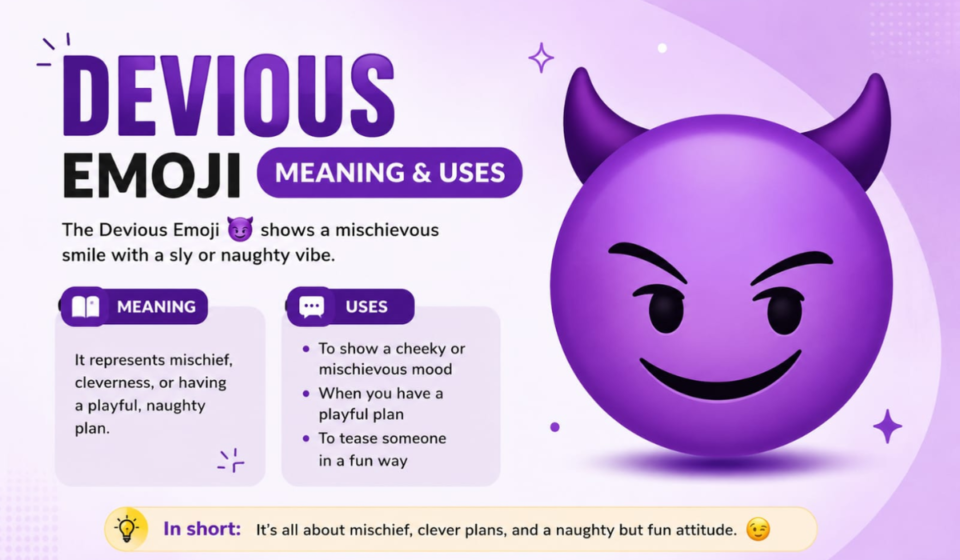

The devious emoji 😈 is a popular choice when you want to add a mischievous, playful, cheeky, or slightly mysterious feeling to a message. It is often used in texts, Instagram captions, comments, DMs, and casual conversations.
While the emoji has a devilish appearance, it does not usually represent something genuinely evil. Depending on the situation, 😈 can show playful trouble, teasing, confidence, flirting, excitement, or a rebellious attitude.
What Do Devious Emoji Mean?
The 😈 emoji is officially known as Smiling Face with Horns. Its smiling expression gives it a playful personality, making it different from emojis that communicate serious anger or hostility.
The most common meanings of 😈 include:
| Meaning | What It Can Express |
| Mischief | Planning something playful |
| Naughtiness | Acting a little cheeky |
| Teasing | Playfully joking with someone |
| Flirting | Adding a suggestive or playful tone |
| Confidence | Showing bold energy |
| Excitement | Looking forward to something |
| Rebellion | Breaking the rules in a harmless way |
| Devilish humor | Making a cheeky joke |
The meaning can change depending on the words surrounding the emoji. For example, “I ate the last cookie 😈” sounds playful, while “You look amazing 😈” may have a flirtatious tone.
Why Is 😈 Called the Devious Emoji?
People often call 😈 the devious emoji because its expression looks like someone who is secretly planning something mischievous. The horns add a devilish appearance, while the smile keeps the overall feeling playful.
That combination makes it useful when you want your message to sound cheeky rather than completely serious.
How to Use Devious Emoji the Right Way
Using 😈 is simple when you first decide what kind of emotion you want your message to communicate. It works best in casual conversations where humor, teasing, confidence, or playful energy is appropriate.
Use 😈 for Playful Mischief
Use the emoji when you’re joking about harmless trouble or pretending that you have a secret plan.
- I have a little surprise for you 😈
- Guess who ate the last slice 😈
- I know something you don’t 😈
- Time to cause some harmless trouble 😈
- I may have a plan 😈
Use 😈 for Teasing
The emoji can make a teasing statement feel more playful and less serious.
- You really thought you could beat me? 😈
- I told you I’d win 😈
- Don’t worry, I’ll behave… maybe 😈
- You should have listened to me 😈
- Better luck next time 😈
Use 😈 for Flirty Messages
The devious emoji can sometimes create a flirty or slightly suggestive tone. This meaning depends heavily on the conversation and relationship between the people involved.
Examples include:
- You look way too good tonight 😈
- You know exactly what you’re doing 😈
- Wait until you see my surprise 😈
- That smile is dangerous 😈
- Maybe I have something planned 😈
Remember that 😈 does not automatically mean flirting. Context is what determines whether the message feels romantic, playful, or simply funny.
Best Devious Emoji Combos Copy & Paste
Combining 😈 with another emoji can make the mood of your message easier to understand. Here are some popular combinations and their possible meanings:
| Emoji Combo | Possible Meaning |
| 😈👀 | Watching, noticing, or plotting |
| 😈😏 | Cheeky or flirty |
| 😈🔥 | Bold and exciting |
| 😈😂 | Funny mischief |
| 😈🤭 | Secretive or cheeky |
| 😈😉 | Playful teasing |
| 😈🖤 | Dark or edgy mood |
| 😈💜 | Cute devilish energy |
| 😈🎃 | Halloween or spooky mood |
| 😈😜 | Playful and naughty |
| 😈🤘 | Rebellious energy |
| 😈✨ | Stylish and mischievous |
| 😈💀 | Chaotic or hilarious energy |
| 😈🙃 | Ironic or intentionally chaotic |
| 😈❤️ | Playful romantic energy |
There is no single official meaning for every emoji combination. People often create their own meanings by combining emojis according to the conversation and mood.
😈 vs 👿: What’s the Difference?
The 😈 and 👿 emojis both have horns, but their expressions give them different meanings.
| Emoji | Name | Common Feeling |
| 😈 | Smiling Face with Horns | Playful, mischievous, cheeky, flirty |
| 👿 | Angry Face with Horns | Angry, hostile, threatening, serious |
The biggest difference is the facial expression. 😈 has a smile, which makes it feel playful and mischievous. 👿 has an angry expression, so it generally feels more aggressive.
If you’re joking with a friend, 😈 is usually more appropriate. If you’re trying to communicate anger or a more threatening devilish mood, 👿 may fit better.
What Does 😈 Mean in Texting?
In texting, 😈 commonly suggests that someone is being playful, mischievous, cheeky, bold, naughty, or slightly suggestive.
The surrounding message is important because the same emoji can communicate different emotions.
For example:
“I ate your fries 😈”
This usually suggests harmless teasing.
“Wait until you see what I bought 😈”
This can create a mysterious or exciting feeling.
“You looked amazing tonight 😈”
This may sound flirtatious.
“Another win for us 😈”
This can show confidence or playful celebration.
So, when someone sends 😈, don’t interpret the emoji by itself. Consider the entire conversation and the person’s usual communication style.
Read This: 300+ Best Nature Captions for Instagram 🍃 | Funny, Peaceful & Aesthetic Ideas
Is 😈 a Flirty Emoji?
Yes, 😈 can be used as a flirty emoji, but flirting is only one of its meanings.
When combined with compliments, romantic messages, teasing, or playful hints, 😈 can make a message feel more suggestive or confident.
For example:
- “You look amazing 😈” — potentially flirty.
- “I stole your fries 😈” — probably playful.
- “I have a surprise for you 😈” — mysterious and possibly flirty.
- “We won again 😈” — confident and playful.
If you’re trying to understand someone’s intention, pay attention to the complete message rather than assuming that 😈 always means flirting.
Devious Emoji for Instagram Captions
The 😈 emoji is perfect for Instagram captions that have a bold, confident, playful, baddie, or mysterious vibe.
Here are some devious emoji captions you can copy and personalize:
- Too sweet to be innocent 😈
- A little trouble never hurt 😈
- Pretty with a mischievous side 😈
- Good vibes with bad ideas 😈
- Looking innocent, thinking otherwise 😈
- Catch me breaking the rules 😈
- Sweet face, devilish energy 😈
- Just a little chaotic 😈
- Born to be a little rebellious 😈
- My innocent era is over 😈
- Main character with a mischievous plot 😈
- Confidence with a side of trouble 😈
- Angel face, troublemaker energy 😇😈
- Smiling because I know something you don’t 😈
- Too playful to behave 😈
- Cute face, dangerous energy 😈
- Serving looks and a little trouble 😈
- Innocent? Never said that 😈
- A little mystery looks good on me 😈
- Sweet but slightly savage 😈
These captions can work well for selfies, mirror pictures, outfit posts, party photos, Instagram Reels, and confident baddie-style content.
When Should You Avoid Using 😈?
Although 😈 is generally playful, it may not be suitable for every situation. Because it can sometimes appear flirty, naughty, or suggestive, it is important to consider who will receive your message.
You may want to avoid using it when:
- The conversation is serious or sensitive.
- You are communicating professionally.
- You are discussing an actual dangerous situation.
- You do not know how the recipient may interpret your tone.
- You want your message to sound completely neutral.
- The emoji could accidentally make your message sound flirtatious.
For casual conversations, 😈 can add personality and humor. For formal communication, leaving it out is usually the safer choice.
Trending Devious Emoji in 2026
In 2026, 😈 continues to fit the short and expressive communication style commonly seen across social media and messaging platforms. It is especially useful when people want to communicate a mood without writing a long explanation.
Popular combinations include:
- 😈👀 — “I see what’s happening.”
- 😈😏 — Cheeky or flirty mood.
- 😈🔥 — Bold and exciting energy.
- 😈🤭 — Secretive or playful mood.
- 😈😂 — Funny mischief.
- 😈🖤 — Dark aesthetic.
- 😈✨ — Playful and stylish.
- 😈🎃 — Devilish Halloween energy.
The popularity of emoji combinations comes from their ability to communicate a complete mood quickly. Instead of writing several sentences, users can combine two or three emojis to create a particular feeling.
Quick Guide to the 😈 Emoji
If you want the simplest explanation, remember:
😈 = “I’m being playful, mischievous, cheeky, naughty, or a little devilish.”
Its meaning can change between:
- Mischief
- Teasing
- Flirting
- Confidence
- Excitement
- Rebellion
- Playful trouble
- Devilish humor
The context is the most important part. A 😈 after a joke may simply mean “I’m being cheeky,” while the same emoji after a romantic message could have a flirty meaning.
Conclusion
The devious emoji 😈 is a fun and flexible emoji that can express mischief, teasing, confidence, naughtiness, excitement, and playful devilish energy. Its smiling face makes it much lighter than an angry or threatening expression.
Whether you’re texting a friend, replying to an Instagram post, creating a caption, or sending a playful DM, 😈 can add personality to your words. Choose it according to the situation and let the rest of your message make your intended meaning clear.
Frequently Asked Questions
What does the devious emoji 😈 mean?
The 😈 emoji usually represents mischief, naughtiness, teasing, playful trouble, confidence, or a devilish mood.
What is the official name of 😈?
The official name of 😈 is Smiling Face with Horns, although many people call it the devil or devious emoji.
Is 😈 a flirty emoji?
It can be flirty when used with romantic or suggestive messages, but it can also simply represent teasing or playful mischief.
What does 😈 mean from a girl?
It may suggest that she is being playful, teasing, mischievous, confident, or possibly flirty, depending on the conversation.
What does 😈 mean from a guy?
It can indicate playful troublemaking, teasing, confidence, or flirtation depending on the context.
What does 😈 mean in texting?
In texting, 😈 commonly adds a mischievous, playful, cheeky, bold, or slightly naughty tone.
What is the difference between 😈 and 👿?
😈 generally communicates playful mischief, while 👿 has a more angry, hostile, or menacing tone.
Can I use 😈 on Instagram?
Yes. 😈 works well in Instagram captions, comments, Stories, Reels, and DMs when its playful or mischievous tone matches your content.